Full Day · Private · All Inclusive
Día Completo · Privado · Todo Incluido

Fatehpur
Sikri
Ghost City

Fatehpur
Sikri
Ciudad Fantasma

In 1571, the greatest emperor of the Mughal world built an entirely new capital in red sandstone on a ridge above the Rajasthani plain. Fourteen years later he abandoned it entirely and never returned. Fatehpur Sikri — the City of Victory — is the most perfectly preserved ghost city in the world: every palace, courtyard, mosque, and hall still standing exactly as Akbar left them, inhabited only by wind and the sound of footsteps on five-century-old stone. This private tour makes full sense of every square metre of it, in English and Spanish.

En 1571, el mayor emperador del mundo mogol construyó una capital completamente nueva en arenisca roja sobre una cresta sobre la llanura rajasthani. Catorce años después la abandonó por completo y nunca volvió. Fatehpur Sikri — la Ciudad de la Victoria — es la ciudad fantasma mejor conservada del mundo: cada palacio, patio, mezquita y salón todavía en pie exactamente como los dejó Akbar, habitados solo por el viento y el sonido de pasos sobre piedra de cinco siglos. Este tour privado da pleno sentido a cada metro cuadrado de todo ello, en inglés y español.

Book via WhatsApp Reservar por WhatsApp

Instant reply · Private tour · Agra or Delhi hotel pickup · All entry tickets included
Respuesta inmediata · Tour privado · Recogida en hotel en Agra o Delhi · Todas las entradas incluidas

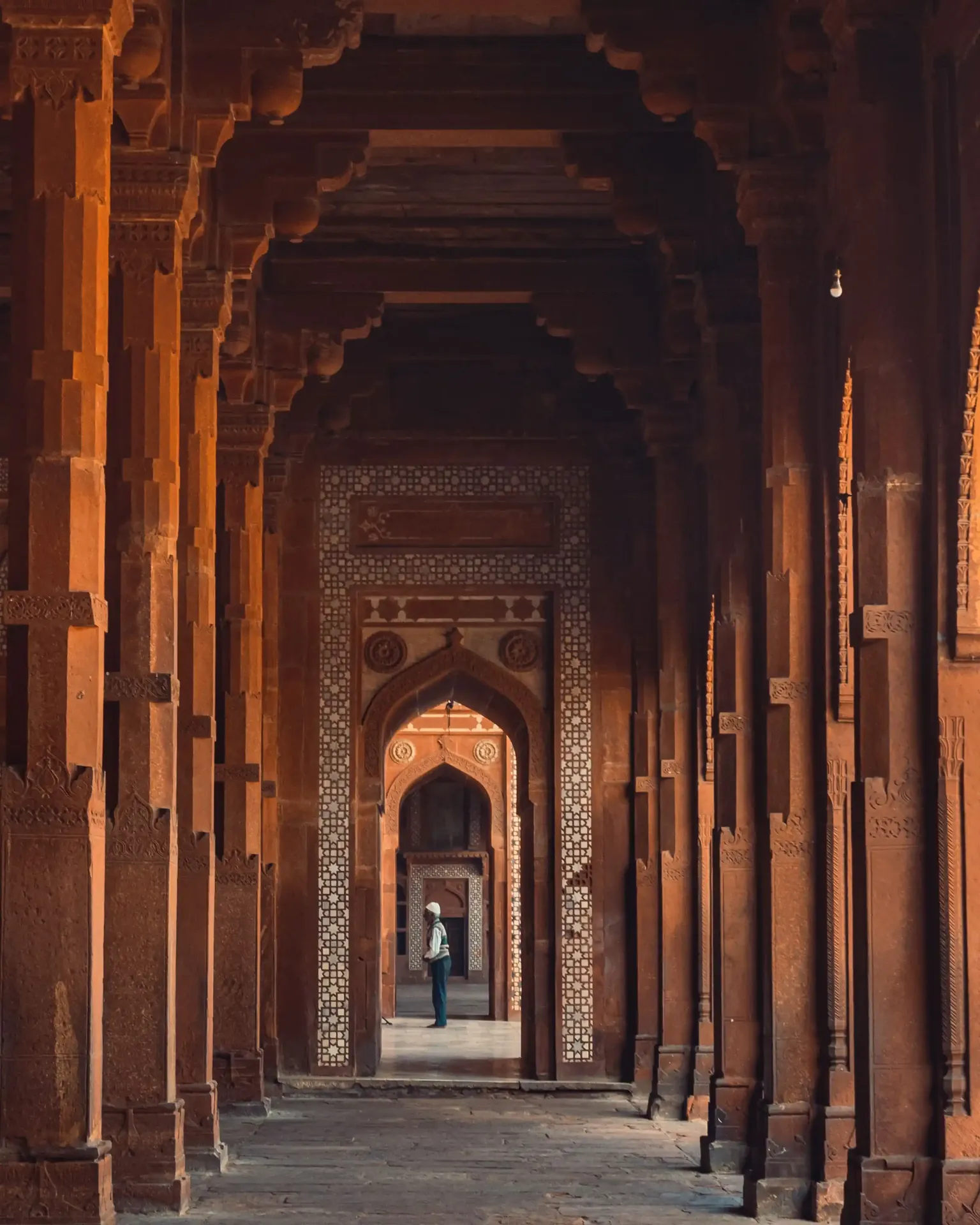
Fatehpur Sikri Buland Darwaza at golden hour — Imperial Ghost City Tour with Kamran Khan
All Inclusive
Todo Incluido
  • UNESCO World Heritage EntryEntrada Patrimonio UNESCO
  • Buland Darwaza — 54 m GateBuland Darwaza — Puerta de 54 m
  • Salim Chishti DargahDargah de Salim Chishti
  • All Palace ComplexesTodos los Complejos Palatinos
  • Private AC Vehicle All DayVehículo AC Privado Todo el Día
🎫
All Entry TicketsEvery monument covered
Todas las EntradasCada monumento cubierto
🏛
Buland DarwazaWorld’s tallest gateway
Buland DarwazaLa puerta más alta del mundo
🚗
AC TransportationPrivate vehicle all day
Transporte ACVehículo privado todo el día
🧭
Licensed GuidePan-India IITG certified
Guía CertificadoIITG oficial
Full DayAgra or Delhi pickup
Día CompletoRecogida en Agra o Delhi

One Day Inside Five Centuries

Un Día Dentro de Cinco Siglos

Fatehpur Sikri was built in fourteen years and abandoned in fourteen more. The reasons are still debated — a water crisis, military overextension, or simply the restlessness of the most powerful man in the world. What it left behind is something that no other place on earth can match: an entire imperial capital frozen at the moment of its desertion, with every building intact and every story still embedded in its stones.

Fatehpur Sikri fue construida en catorce años y abandonada en otros catorce. Las razones todavía se debaten — una crisis de agua, sobreextensión militar, o simplemente la inquietud del hombre más poderoso del mundo. Lo que dejó atrás es algo que ningún otro lugar en la tierra puede igualar: una capital imperial entera congelada en el momento de su deserción, con cada edificio intacto y cada historia aún incrustada en sus piedras.

01
Morning · 8:00 AM
Mañana · 8:00 AM
Hotel Pickup — Agra or Delhi
Recogida en Hotel — Agra o Delhi
Your private, air-conditioned vehicle arrives at your hotel for the morning departure. Guests staying in Agra depart at 8:00 AM for the 40-kilometre drive southwest along the Agra–Jaipur highway, passing through the agricultural heartland of western Uttar Pradesh before the ridge of Fatehpur Sikri appears on the horizon — a long, low line of red sandstone elevated above the surrounding plain, exactly as it appeared to Akbar’s generals when they first surveyed this site in 1568. Guests travelling from Delhi depart earlier to allow for the approximately 200-kilometre journey; confirm your exact pickup time with Kamran at booking. The drive is Kamran’s opportunity to brief you on Emperor Akbar — the third and greatest Mughal emperor, son of Humayun, whose reign from 1556 to 1605 defined the political, artistic, and intellectual high point of the Mughal empire — and on the specific circumstances that led to the founding of Fatehpur Sikri: the childlessness that haunted Akbar for years, the visit to the Sufi saint Salim Chishti that he believed resulted in the birth of his heir, and the decision to honour that debt by building an entirely new capital on the saint’s ridge.
Tu vehículo privado con aire acondicionado llega a tu hotel para la salida matutina. Los huéspedes alojados en Agra salen a las 8:00 h para el trayecto de 40 kilómetros al suroeste por la carretera Agra–Jaipur, hasta que la cresta de Fatehpur Sikri aparece en el horizonte — una larga línea baja de arenisca roja elevada sobre la llanura circundante. Los huéspedes que viajan desde Delhi salen antes para el trayecto de aproximadamente 200 kilómetros. El trayecto es la oportunidad de Kamran para informaros sobre el Emperador Akbar — el tercer y mayor emperador mogol — y sobre las circunstancias específicas que llevaron a la fundación de Fatehpur Sikri: la falta de hijos que atormentaba a Akbar, la visita al santo sufí Salim Chishti y la decisión de honrar esa deuda construyendo una capital completamente nueva.
Private Pickup · Agra Hotel or Delhi Hotel Recogida Privada · Hotel en Agra o Delhi
02
Morning · 9:00 AM
Mañana · 9:00 AM
Arrival at Fatehpur Sikri — The Ridge Approach
Llegada a Fatehpur Sikri — La Aproximación por la Cresta
We arrive at the base of the ridge and ascend by the access road that runs along its eastern face. The approach to Fatehpur Sikri from below is deliberately considered: as the red sandstone walls of the city rise above the plain, you understand immediately why Akbar chose this site. The ridge sits 26 metres above the surrounding countryside, commanding views in every direction across the flat Rajasthani-Uttar Pradesh plain, naturally defensible on three sides, and blessed with a lake — the Fateh Sagar — that once stretched along its western base. The lake, which historians believe supplied the water that sustained the city for its fourteen-year existence, had silted up by the time Akbar moved his court to Lahore in 1585. Whether water scarcity was the true reason for the abandonment, or one of several converging pressures, remains one of the most interesting arguments in Mughal historiography. Kamran will introduce this debate as you ascend, so that the question is present in your mind when you stand inside the city that it concerns.
Llegamos a la base de la cresta y ascendemos por la carretera de acceso que corre a lo largo de su cara oriental. La aproximación a Fatehpur Sikri desde abajo es deliberadamente considerada: a medida que las murallas de arenisca roja de la ciudad se alzan sobre la llanura, entiendes inmediatamente por qué Akbar eligió este lugar. La cresta se asienta 26 metros por encima del campo circundante. El lago que los historiadores creen que abasteció a la ciudad durante sus catorce años de existencia se haba colmatado cuando Akbar trasladó su corte a Lahore en 1585. Si la escasez de agua fue la verdadera razón del abandono sigue siendo uno de los debates más interesantes de la historiografía mogola.
UNESCO World Heritage · Ridge Approach · Historical Context Patrimonio UNESCO · Aproximación a la Cresta · Contexto Histórico
03
Morning · 9:30 AM
Mañana · 9:30 AM
Buland Darwaza — The Gate of Victory
Buland Darwaza — La Puerta de la Victoria
We enter the Jama Masjid complex through its rear bazaar approach, ascending the 42 steps that lead to the base of the Buland Darwaza — the Gate of Magnificence — and stopping at its base to look upward. At 54 metres from ground to finial, the Buland Darwaza is the tallest gateway in the world: taller than the Arc de Triomphe by 13 metres, taller than any gate ever built by any civilization in any period of history. It was added to the Jama Masjid in 1576 by Akbar to commemorate his conquest of Gujarat, and its proportions were calculated specifically to dwarf the human body at its base — the gateway is a statement about the relationship between a ruler and his subjects, between the divine and the terrestrial, between the ambition of a man and the smallness of the world he sought to govern. The inscription above the central arch, in Persian and Arabic, reads: “The world is a bridge. Pass over it, but build no houses on it. He who hopes for an hour may hope for eternity. The world endures but an hour. Spend it in prayer, for the rest is unseen.” Kamran will read and translate this inscription at the gate. It is the most important sentence in Fatehpur Sikri and the most important instruction Akbar left behind.
Entramos al complejo de la Jama Masjid por su aproximación trasera de bazar, subiendo los 42 escalones que llevan a la base del Buland Darwaza — la Puerta de la Magnificencia — y deteníendonos en su base para mirar hacia arriba. A 54 metros desde el suelo hasta el remate, el Buland Darwaza es la puerta más alta del mundo: más alta que el Arco de Triunfo por 13 metros. Fue añadida a la Jama Masjid en 1576 por Akbar para conmemorar su conquista de Gujarat. La inscripción sobre el arco central, en persa y árabe, dice: “El mundo es un puente. Crúzalo, pero no construyas casas en él.” Kamran leerá y traducirá esta inscripción en la puerta.
54 m — World’s Tallest Gateway · 1576 CE · Ticket Included 54 m — Puerta Más Alta del Mundo · 1576 d.C. · Entrada Incluida
04
Morning · 10:00 AM
Mañana · 10:00 AM
Jama Masjid & the Dargah of Salim Chishti
Jama Masjid y la Dargah de Salim Chishti
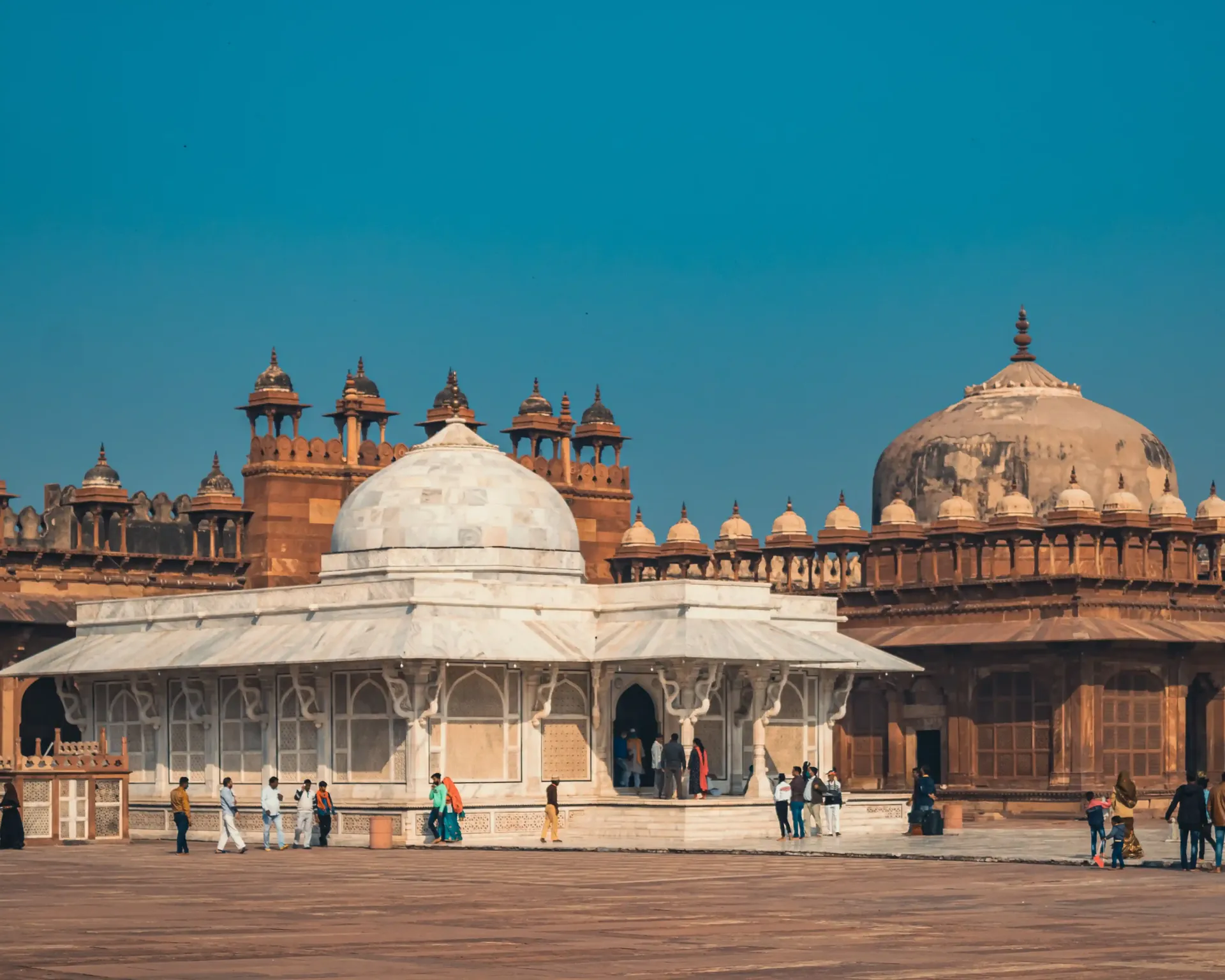
We enter the great courtyard of the Fatehpur Sikri Jama Masjid — the mosque that Akbar built as the spiritual heart of his new capital, its sandstone courtyard large enough to contain several thousand worshippers and centred on the white marble tomb of the Sufi saint whose blessing had, in Akbar’s belief, given him the son he had prayed for. Sheikh Salim Chishti was a Sufi mystic of the Chishti order, already resident on the Fatehpur ridge when Akbar came to seek his intercession. He predicted the birth of a son; the son arrived; Akbar named the boy Salim after the saint, built a city around the saint’s home, and after the saint’s death in 1572 built him the most perfect marble tomb in Mughal architecture. The Dargah of Salim Chishti is the most refined piece of craftsmanship in Fatehpur Sikri: its jali screens — the latticed marble windows that regulate light and air — are carved in a single piece from marble to a fineness that approaches the threshold of translucency. The saint’s tomb continues to receive devotees from across India and the world, and the custom of tying a thread to the jali and making a wish persists here as it has for over four centuries. Kamran will explain the theology and history of the Chishti Sufi order, its relationship with the Mughal dynasty, and Akbar’s own extraordinarily complex and syncretic spiritual life, which made him simultaneously the patron of Islamic saints, Hindu temples, Zoroastrian fire worship, and Christian Jesuit priests.
Entramos en el gran patio de la Jama Masjid de Fatehpur Sikri — la mezquita que Akbar construyó como corazón espiritual de su nueva capital, centrada en la tumba de mármol blanco del santo sufí cuya bendición le había dado el hijo por el que había rezado. El Jeque Salim Chishti era un místico sufí de la orden Chishti. Predijo el nacimiento de un hijo; el hijo nació; Akbar nombró al niño Salim en honor al santo y construyó una ciudad alrededor del hogar del santo. La Dargah de Salim Chishti es la pieza de artesanía más refinada de Fatehpur Sikri: sus pantallas de jali — las ventanas de mármol calado — están talladas en una sola pieza de mármol con una finura que se aproxima al umbral de la translucidez. Kamran explicará la teología y la historia de la orden sufí Chishti y la extraordinariamente compleja vida espiritual sintética de Akbar.
Salim Chishti Dargah · Marble Jali · Living Shrine · Ticket Included Dargah Salim Chishti · Jali de Mármol · Santuario Vivo · Entrada Incluida
05
Late Morning · 11:00 AM
Mañana Avanzada · 11:00 AM
The Imperial Palace Complex — Diwan-i-Am & Diwan-i-Khas
El Complejo del Palacio Imperial — Diwan-i-Am y Diwan-i-Khas
We cross from the mosque complex into the imperial precinct — the administrative and residential core of Akbar’s capital, entered through a separate ticketed gate. The Diwan-i-Am (Hall of Public Audience) is the first structure we encounter: a large sandstone pavilion open on three sides, where Akbar held public court on a throne set on an elevated stone platform, surrounded by his nobles in ranked seating below. The scale communicates the nature of Mughal governance precisely — magnificent enough to awe, open enough to approach. Immediately beyond it stands the Diwan-i-Khas (Hall of Private Audience): from the outside, an unremarkable two-storey structure; from inside, one of the most extraordinary rooms ever designed. At its centre stands a single stone column whose shaft, carved in four tiers of stacked bracket capitals, supports a circular platform connected to the four corners of the room by narrow suspended stone bridges. Akbar sat on this platform during private audiences with his advisors, accessible only by crossing one of the four bridges, physically elevated above every other person in the room. No structural support from below. No cables or concealed ironwork. Pure tensile stone. The column is Fatehpur Sikri’s most photographed element and its most discussed engineering problem. Kamran will explain both the architectural ingenuity and the political symbolism of what you are standing inside.
Cruzamos del complejo de la mezquita al recinto imperial — el núcleo administrativo y residencial de la capital de Akbar. El Diwan-i-Am (Salón de Audiencia Pública) es la primera estructura que encontramos: un gran pabellón de arenisca abierto por tres lados, donde Akbar celebraba la corte pública. Inmediatamente más allá se encuentra el Diwan-i-Khas (Salón de Audiencia Privada): desde el exterior, una estructura de dos plantas sin pretensiones; desde el interior, una de las habitaciones más extraordinarias jamás diseñadas. En su centro se alza una única columna de piedra cuyo fuste, tallado en cuatro niveles de capiteles en ménsula apilados, soporta una plataforma circular conectada a las cuatro esquinas de la habitación por estrechos puentes de piedra suspendidos. Pura tensión en piedra. Kamran explicará tanto el ingenio arquitectónico como el simbolismo político.
Diwan-i-Khas Central Column · Imperial Precinct · Ticket Included Columna Central Diwan-i-Khas · Recinto Imperial · Entrada Incluida
06
Late Morning · 11:45 AM
Mañana Avanzada · 11:45 AM
Panch Mahal, Anup Talao & Birbal’s House
Panch Mahal, Anup Talao y Casa de Birbal
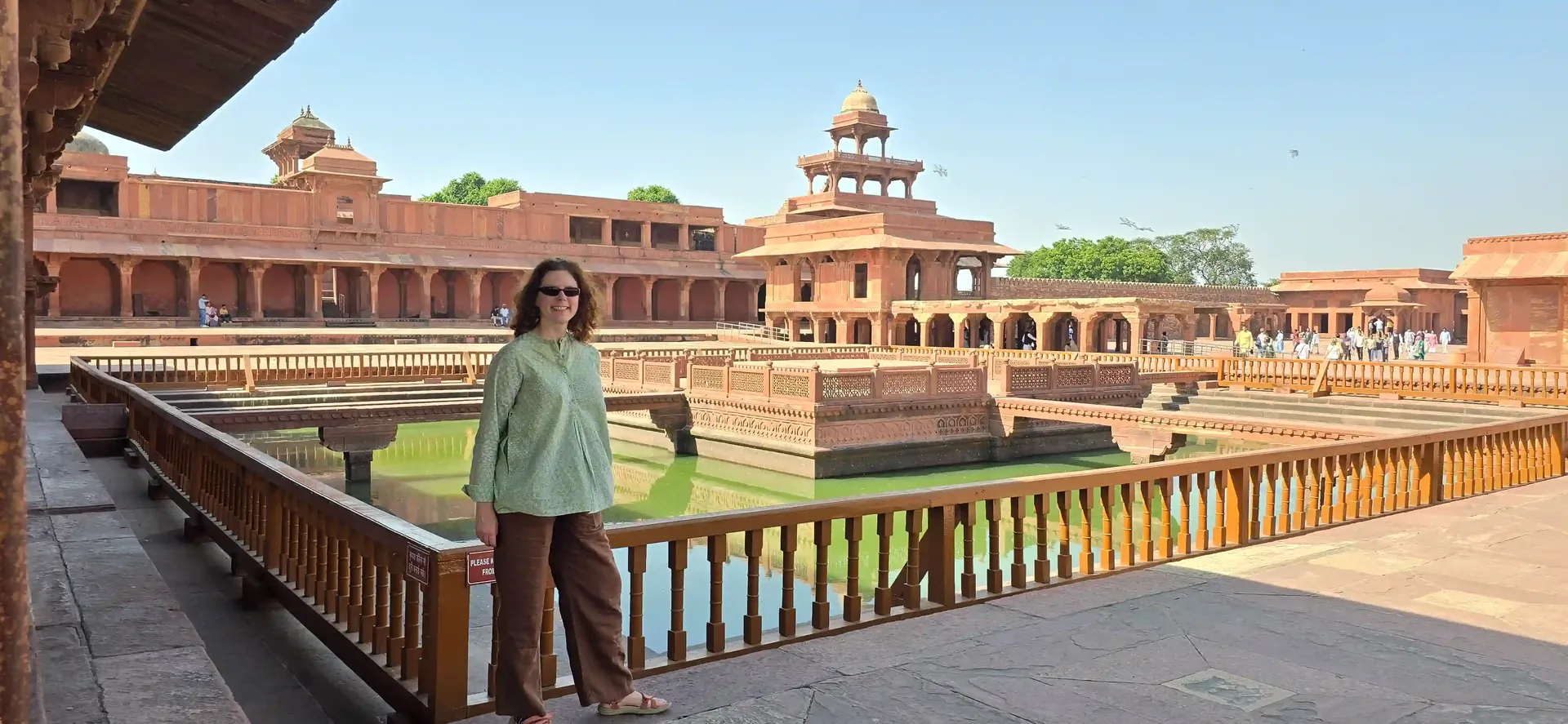
The Panch Mahal is Fatehpur Sikri’s most visually distinctive structure: a five-storey open pavilion on the eastern edge of the imperial terrace, its columns at each successive floor decreasing in number from 84 at the ground level to a single kiosk at the summit, the whole thing arranged in perfect mathematical ratio. It was used as an evening retreat — catching the breeze from the plain below — and possibly as an astronomical observation platform from its upper level. Adjacent is the Anup Talao — the incomparable pool, a square ornamental tank with a central stone platform connected to the bank by four stone bridges, at which Akbar is said to have held philosophical discussions, seated with his scholars on the central platform surrounded by water. The pool demonstrates Akbar’s court culture in one architectural image: an emperor who crossed water to sit at the intellectual centre, equidistant from every direction. Birbal’s House — traditionally attributed to Akbar’s favourite minister and wit, the Hindu Brahmin Raja Birbal — is the most ornately carved residential structure in the complex, its external walls dense with floral, geometric, and figurative sandstone carving that includes Hindu motifs — a tangible expression of Akbar’s religious tolerance and his policy of appointing Hindus to the highest positions of imperial administration.
El Panch Mahal es la estructura visualmente más distintiva de Fatehpur Sikri: un pabellón abierto de cinco pisos en el borde oriental de la terraza imperial, con columnas en cada piso sucesivo que disminuyen en número de 84 a nivel del suelo a un solo quiosco en la cima. Adyacente está el Anup Talao — el incomparable estanque — un tanque cuadrado ornamental con una plataforma central de piedra conectada a la orilla por cuatro puentes, en el que se dice que Akbar celebraba debates filosóficos. La Casa de Birbal es la estructura residencial más ornamentalmente tallada del complejo, con motivos hindúes — expresión tangible de la tolerancia religiosa de Akbar.
Panch Mahal 5 Storeys · Anup Talao · Birbal’s House Panch Mahal 5 Pisos · Anup Talao · Casa de Birbal
07
Midday · 12:30 PM
Mediodía · 12:30 PM
Jodha Bai’s Palace & the Zenana Precinct
Palacio de Jodha Bai y el Recinto del Zenana
The largest residential structure at Fatehpur Sikri is the palace conventionally attributed to Jodha Bai — Akbar’s principal Rajput Hindu wife — though modern historians prefer the broader designation “royal harem quarters” given the complexity of the imperial household. It is a self-contained palace-within-a-city, with its own internal courtyard, private temple, kitchen gardens, and a zenana (women’s quarter) arrangement that is architecturally distinct from the adjoining male administrative precinct. The building synthesises two architectural vocabularies that had previously remained separate: the Islamic Persian planning tradition of the Mughal court and the Hindu Rajput domestic architectural tradition of its female occupants. The result is a palace whose sandstone is worked in both Mughal geometric patterns and Rajput bracket and cornice details, its spaces calibrated for both prayer and domestic life, its walls carrying both Arabic inscriptions and Hindu figural motifs. This synthesis is Akbar’s political programme rendered in stone — the most concrete expression of his Din-i-Ilahi (Divine Faith) ideology, the syncretic religious philosophy he attempted to found as a reconciliation of Islam, Hinduism, Zoroastrianism, and Christianity. Kamran will give you the full context of Akbar’s religious liberalism and what it meant for the architecture of the building you are standing in.
La estructura residencial más grande de Fatehpur Sikri es el palacio convencionalmente atribuido a Jodha Bai — la principal esposa rajput hindú de Akbar. Es un palacio-dentro-de-una-ciudad autónomo, con su propio patio interior, templo privado y jardines. El edificio sintetiza dos vocabularios arquitectónicos que anteriormente habían permanecido separados: la tradición de planificación persa islámica de la corte mogola y la tradición doméstica arquitectónica rajput hindú de sus ocupantes femeninas. Esta síntesis es el programa político de Akbar vertido en piedra — la expresión más concreta de su ideología Din-i-Ilahi. Kamran os dará el contexto completo del liberalismo religioso de Akbar.
Jodha Bai’s Palace · Zenana Precinct · Hindu-Mughal Synthesis Palacio de Jodha Bai · Recinto Zenana · Síntesis Hindú-Mogol
08
Afternoon · 1:30 PM
Tarde · 1:30 PM
Lunch — Fatehpur Sikri Town
Almuerzo — Ciudad de Fatehpur Sikri
A well-earned pause at a carefully chosen restaurant in Fatehpur Sikri town at the base of the ridge. The town is small, authentic, and largely untouched by the tourist infrastructure that surrounds Agra — its restaurants serve the food that the locals eat, and the quality is uniformly excellent. Kamran will recommend specific dishes: the biryani cooked in the dum style (sealed pot, slow-cooked on low heat for two hours) that is a speciality of this region of Uttar Pradesh, the seekh kebabs grilled over charcoal, the dal that has been simmering since morning, and the freshly baked roti that comes straight from the tandoor to the table. The meal is also the natural moment to continue the morning’s conversation — the abandonment mystery, Akbar’s religious philosophy, the engineering of the Diwan-i-Khas column, the inscription above the Buland Darwaza. Kamran will answer every question the morning raised. Note: lunch costs are not included in the package price and are paid directly at the restaurant.
Una pausa bien merecida en un restaurante cuidadosamente elegido en la ciudad de Fatehpur Sikri al pie de la cresta. La ciudad es pequeña, auténtica y en gran parte no tocada por la infraestructura turística que rodea a Agra. Kamran recomendará platos específicos: el biryani cocido al estilo dum, los seekh kebabs a la brasa de carbón, el dal que ha estado a fuego lento desde la mañana y el roti recién horneado. La comida es el momento natural para continuar la conversación de la mañana. Nota: el coste del almuerzo no está incluido en el precio del paquete y se paga directamente en el restaurante.
Lunch Not Included · Authentic Local Restaurant Almuerzo No Incluido · Restaurante Local Auténtico
09
Afternoon · 2:30 PM
Tarde · 2:30 PM
The Ridge Panorama & The Abandonment Walk
El Panorama de la Cresta y el Paseo del Abandono
After lunch, we return to the site for the final section of the tour: the panoramic walk along the northern edge of the imperial terrace, which offers the clearest views of the city’s full extent and its relationship to the landscape that surrounds it. From this vantage point you can see simultaneously the mosque complex to the west, the palace precinct to the east, the dry bed of the Fateh Sagar lake to the northwest, and the ridge road descending to the plain below — the road down which Akbar’s court processed when it left for the last time in 1585. Kamran uses this panorama to walk through the abandonment question one final time — the water argument, the military logistics argument, and the political argument about Akbar’s personal restlessness and his known preference for peripatetic governance. The site is almost always quieter in the afternoon than the morning — the day visitors have largely departed — and the red sandstone in the afternoon light takes on a quality of depth and warmth that the morning does not have. Photography at this hour is exceptional.
Después del almuerzo, regresamos al sitio para la sección final del tour: el paseo panorámico a lo largo del borde norte de la terraza imperial, que ofrece las vistas más claras de la extensión completa de la ciudad. Desde este punto puedes ver simultáneamente el complejo de la mezquita al oeste, el recinto del palacio al este, el lecho seco del lago Fateh Sagar al noroeste y la carretera de la cresta descendiendo a la llanura — el camino por el que la corte de Akbar procesó cuando la dejó por última vez en 1585. La arenisca roja en la luz de la tarde toma una calidad de profundidad y calidez que la mañana no tiene. La fotografía a esta hora es excepcional.
Ridge Panorama · Afternoon Light · The Abandonment Question Panorama de la Cresta · Luz de Tarde · La Pregunta del Abandono
10
Evening · 4:30 PM
Tarde-Noche · 4:30 PM
Drop-off — Agra or Delhi
Regreso — Agra o Delhi
Your private AC vehicle departs Fatehpur Sikri and returns you to your Agra hotel by approximately 5:30 PM, or begins the drive back to Delhi arriving at approximately 8:30–9:00 PM depending on traffic. For guests combining Fatehpur Sikri with the Taj Mahal on a two-day Agra visit, Kamran can also arrange the return via the Taj Mahal for a late-afternoon sunset pass at the exterior gates and the Taj by Moonlight visit if the timing aligns with a full moon period (ask via WhatsApp at booking). Fatehpur Sikri is not the Taj Mahal. It does not have one image that the world already knows. What it has instead is something rarer: a place where you can stand entirely inside the ambition and the imagination of a civilisation at its peak, in a silence that five centuries have not disturbed.
Tu vehículo AC privado parte de Fatehpur Sikri y te devuelve a tu hotel de Agra a las 17:30 h aproximadamente, o comienza el trayecto de regreso a Delhi llegando a las 20:30–21:00 h según el tráfico. Para los huéspedes que combinan Fatehpur Sikri con el Taj Mahal en una visita de dos días a Agra, Kamran también puede organizar el regreso por el Taj Mahal para un pase de atardecer al anochecer (consultar por WhatsApp al reservar). Fatehpur Sikri es un lugar donde puedes estar completamente dentro de la ambición y la imaginación de una civilización en su punto álgido, en un silencio que cinco siglos no han perturbado.
Drop-off Agra or Delhi · Taj Sunset Extension Available Regreso a Agra o Delhi · Extensión Atardecer Taj Disponible

Inclusions & Exclusions

Inclusiones y Exclusiones

✅ Package Inclusions✅ El Paquete Incluye

  • Private AC Vehicle — Full Day:Vehículo AC Privado — Día Completo: Full-day private air-conditioned transportation for all transfers, including Agra–Fatehpur Sikri–Agra or Delhi–Fatehpur Sikri–Delhi, with a professional driver throughout.Transporte privado con AC durante todo el día para todos los traslados incluyendo Agra–Fatehpur Sikri–Agra o Delhi–Fatehpur Sikri–Delhi, con conductor profesional.
  • Hotel Pickup & Drop-off:Recogida y Regreso en Hotel: Door-to-door service from and to your Agra or Delhi hotel. Airport and railway station pickup available on request.Servicio puerta a puerta desde y hasta tu hotel de Agra o Delhi. Recogida en aeropuerto y estación de tren disponible bajo petición.
  • Fatehpur Sikri UNESCO Entry Ticket:Entrada UNESCO a Fatehpur Sikri: Full entry to both ticketed sections of Fatehpur Sikri — the Jama Masjid & Buland Darwaza complex and the separate Imperial Palace Precinct — for all group members.Entrada completa a ambas secciones con entrada de Fatehpur Sikri — el complejo de la Jama Masjid y el Buland Darwaza, y el recinto del Palacio Imperial por separado — para todos los miembros del grupo.
  • Government Licensed Tour Guide:Guía Oficial Certificado: Full-day service by Kamran Khan in English and Spanish. Pan-India IITG licence. Architectural narration, Mughal history, and full Fatehpur Sikri contextual guidance throughout.Servicio de día completo de Kamran Khan en inglés y español. Licencia IITG panindiana. Narración arquitectónica, historia mogola y orientación contextual completa de Fatehpur Sikri.
  • Water Throughout the Day:Agua Durante Todo el Día: Bottled water provided throughout the tour, including inside the vehicle and at the site.Agua embotellada proporcionada durante todo el tour, incluyendo dentro del vehículo y en el sitio.

✕ Package Exclusions✕ El Paquete Excluye

  • Lunch & All Meals:Almuerzo y Todas las Comidas: Meal costs are not included. Kamran will take you to a quality local restaurant in Fatehpur Sikri town; you pay directly.El coste de las comidas no está incluido. Kamran te llevará a un restaurante local de calidad en la ciudad de Fatehpur Sikri; pagas directamente.
  • Taj Mahal Entry (if extension taken):Entrada al Taj Mahal (si se realiza la extensión): If a Taj Mahal sunset or moonlight extension is added at the end of the day, the Taj Mahal entry ticket is an additional cost. Ask Kamran via WhatsApp at booking.Si se añade una extensión de atardecer o luz de luna al Taj Mahal al final del día, la entrada al Taj Mahal es un coste adicional. Consultar a Kamran por WhatsApp al reservar.
  • Gratuities & Tips:Propinas: Optional and entirely at your discretion for the driver and guide.Opcionales y totalmente a tu criterio para el conductor y el guía.
  • Personal Expenses:Gastos Personales: Souvenirs, handicrafts from the bazaar at the Buland Darwaza base, photography equipment, or any activities not listed in the itinerary.Recuerdos, artesanías del bazar en la base del Buland Darwaza, equipo fotográfico o actividades no incluidas en el itinerario.
  • Alcoholic Beverages:Bebidas Alcohólicas: Any drinks ordered beyond water and standard non-alcoholic beverages.Cualquier bebida pedida más allá del agua y las bebidas no alcohólicas estándar.
  • Accommodation in Agra:Alojamiento en Agra: If you choose to base yourself in Agra for the Fatehpur Sikri day trip, hotel accommodation is not included. Kamran can recommend properties at every price point.Si eliges alojarte en Agra para la excursión de un día a Fatehpur Sikri, el alojamiento en hotel no está incluido. Kamran puede recomendar propiedades en todos los rangos de precio.

What Makes This Different

Qué lo Hace Diferente

01
The Inscription at the Gate
La Inscripción en la Puerta
The six-line Persian and Arabic inscription above the Buland Darwaza arch is one of the most extraordinary pieces of text in Mughal history — a meditation on impermanence carved into the world’s tallest gate by the world’s most powerful man. Most guides walk past it. Kamran reads it to you, translates it line by line, and tells you what it meant to the man who put it there.
La inscripción de seis líneas en persa y árabe sobre el arco del Buland Darwaza es uno de los textos más extraordinarios de la historia mogola — una meditación sobre la impermanencia tallada en la puerta más alta del mundo por el hombre más poderoso del mundo. La mayoría de los guías pasan por delante. Kamran te la lee, la traduce línea por línea y te dice lo que significaba para el hombre que la puso allí.
02
The Column That Should Fall
La Columna Que Debería Caer
The central column of the Diwan-i-Khas is one of the most audacious structural achievements in Mughal architecture. A single shaft of sandstone supporting a circular platform connected to four corners by suspended stone bridges, with no mechanical support from below. Kamran will stand you at each of the four bridges and explain both the engineering and the political metaphor it embodies.
La columna central del Diwan-i-Khas es uno de los logros estructurales más audaces de la arquitectura mogola. Un único fuste de arenisca soportando una plataforma circular conectada a cuatro esquinas por puentes de piedra suspendidos. Kamran te situará en cada uno de los cuatro puentes y explicará tanto la ingeniería como la metáfora política que encarna.
03
A City Nobody Lives In
Una Ciudad en la que Nadie Vive
Fatehpur Sikri receives a fraction of the visitors that come to the Taj Mahal, even though it is a more complex and in many ways more interesting site. The relative absence of crowds allows a quality of attention and conversation that busy monuments make impossible. You can stand in the Diwan-i-Khas and hear nothing for minutes at a time. That silence is part of what the site gives you.
Fatehpur Sikri recibe una fracción de los visitantes que van al Taj Mahal, aunque es un sitio más complejo y en muchos sentidos más interesante. La ausencia relativa de multitudes permite una calidad de atención y conversación que los monumentos concurridos hacen imposible. Puedes quedarte en el Diwan-i-Khas y no escuchar nada durante minutos seguidos.
04
Akbar’s Religious Synthesis
La Síntesis Religiosa de Akbar
No building in India contains a more concentrated expression of Akbar’s extraordinary cultural and religious eclecticism than Fatehpur Sikri. The same complex holds a Sufi saint’s living dargah, a mosque that borrowed structural ideas from Hindu temple architecture, a palace whose decoration synthesises Islamic, Hindu, and Buddhist motifs, and a hall designed for interfaith philosophical debate. Kamran will connect all of these in a single coherent narrative.
Ningún edificio en la India contiene una expresión más concentrada del extraordinario eclecticismo cultural y religioso de Akbar que Fatehpur Sikri. El mismo complejo alberga una dargah sufí viva, una mezquita, un palacio cuya decoración sintetiza motivos islámicos, hindúes y budistas, y un salón diseñado para el debate filosófico interreligioso. Kamran conectará todos estos elementos en una única narrativa coherente.
05
Bilingual Guide
Guía Bilingüe
Kamran speaks fluent English and Spanish — a rare combination at Fatehpur Sikri. The full depth of Akbar’s architecture, political philosophy, religious syncretism, and the abandonment mystery is available in both languages, without losing a single layer of context.
Kamran habla inglés y español con fluidez — una combinación poco frecuente en Fatehpur Sikri. La profundidad total de la arquitectura de Akbar, la filosofía política, el sincretismo religioso y el misterio del abandono está disponible en ambos idiomas.
06
500+ Five-Star Reviews
Más de 500 Reseñas de 5 Estrellas
Verified reviews on Viator, GetYourGuide, and Airbnb from travellers across 40+ nationalities — all five stars. Read them before you book.
Reseñas verificadas en Viator, GetYourGuide y Airbnb de viajeros de más de 40 nacionalidades — todas de cinco estrellas. Léelas antes de reservar.

Practical Details

Información Práctica

Duration
Duración
Full Day — Approx. 8–12 Hours
Día Completo — Aprox. 8–12 Horas
From Agra: 8:00 AM – 5:30 PM. From Delhi: 6:00 AM – 9:00 PM (confirm with Kamran at booking). Flexible on request.
Desde Agra: 8:00 – 17:30 h. Desde Delhi: 6:00 – 21:00 h (confirmar con Kamran al reservar). Flexible bajo petición.
Group Size
Tamaño del Grupo
1 to 8 Persons
1 a 8 Personas
Entirely private. Larger groups on request.
Completamente privado. Grupos más grandes bajo petición.
Languages
Idiomas
English & Spanish
Inglés y Español
Hindi and Urdu also available.
Hindi y urdu también disponibles.
Availability
Disponibilidad
All Year · 7 Days a Week
Todo el Año · 7 Días a la Semana
Last-minute bookings welcome. Best visited October–March for comfortable temperatures. April–June is hot but the site is emptier and the sandstone colour more vivid.
Se aceptan reservas de última hora. Mejor visitada de octubre a marzo para temperaturas cómodas. Abril–junio es caluroso pero el sitio está más vacío y el color de la arenisca más vivo.
Meeting Point
Punto de Encuentro
Hotel Pickup — Agra or Delhi
Recogida en Hotel — Agra o Delhi
Share your hotel address via WhatsApp — we arrange the rest. Agra Cantt. Railway Station and Delhi IGI Airport pickup also available on request.
Comparte tu dirección de hotel por WhatsApp — nosotros organizamos el resto. Recogida en la Estación Agra Cantt. y el Aeropuerto IGI de Delhi también disponible bajo petición.
What to Wear
Cómo Vestirse
Modest, comfortable clothing & closed flat shoes
Ropa discreta, cómoda y zapatos planos cerrados
Modest dress is required throughout Fatehpur Sikri — both in the Jama Masjid mosque complex and the Salim Chishti Dargah. Shoulders and knees must be covered for both men and women as a mandatory site regulation; head coverings are provided for women at the Dargah entrance at no charge. Shoes are removed before entering the Dargah of Salim Chishti and the inner mosque. Comfortable, flat, closed shoes are strongly recommended: the site involves extensive walking over uneven red sandstone surfaces, steep narrow staircases in certain structures, and open-air terraces where the stone can be hot underfoot in summer. A hat or cap and sun protection are essential for the open-air sections. A warm layer is advisable for the early morning departure in winter months (November–February).
Se requiere ropa discreta en todo Fatehpur Sikri — tanto en el complejo de la mezquita Jama Masjid como en la Dargah de Salim Chishti. Los hombros y las rodillas deben estar cubiertos para hombres y mujeres como regulación obligatoria del sitio. Se retiran los zapatos antes de entrar en la Dargah y en la mezquita interior. Se recomiendan encarecidamente zapatos planos, cerrados y cómodos: el sitio implica caminar extensamente sobre superficies de arenisca roja irregulares. Un sombrero y protección solar son esenciales para las secciones al aire libre.
What to Bring
Qué Llevar
Essential Items for the Tour
Artículos Esenciales para el Tour
Camera & Wide-Angle Lens (Strongly Recommended): Fatehpur Sikri is one of the most photographically rich monuments in India — but it rewards the wide-angle lens rather than the telephoto. The Buland Darwaza is too tall to capture in full frame with a standard focal length; you need wide angle to include both the gate and the foreground steps in a single composition. The Diwan-i-Khas interior requires a 16–24mm equivalent to capture the central column and its four bridges in context. The Panch Mahal’s five receding tiers are best captured with a slight wide-angle perspective from the Anup Talao pool below. Fully charged batteries and at least one spare memory card are recommended; there is no convenient charging point on site.

Large Light-Coloured Scarf or Dupatta (Women): Required for covering the head when entering the Dargah of Salim Chishti. The head covering provided at the Dargah entrance is a simple cloth that is functional but not particularly comfortable over a long visit. A personal light-coloured or neutral scarf carried in your day bag allows you to enter without interruption and covers shoulders and head simultaneously when required. The same scarf provides useful sun coverage on the open upper terraces.

Comfortable Socks: You will remove your shoes at the Dargah of Salim Chishti and at the inner mosque. Clean, comfortable socks make this effortless. The sandstone floor inside the Dargah complex is smooth and cool in the morning but warm from midday onward — socks provide both comfort and respectfulness.

Sun Protection (April–October Critical): Fatehpur Sikri sits on an open ridge exposed to sun on all sides, with very limited shade in the imperial palace precinct. April–October temperatures in this part of Uttar Pradesh reach 38–45°C at midday. SPF 50+ sunscreen, UV-protective sunglasses (Category 3 minimum), and a wide-brimmed hat or cap are not optional in these months — they are essential. Apply sunscreen before leaving the vehicle; the walkway from the car park to the Buland Darwaza steps is fully exposed. Reapply every ninety minutes during the site visit.

Reusable Water Bottle (Large Capacity): Bottled water is provided in the vehicle. A large-capacity reusable bottle (minimum 1 litre) that you can fill from the vehicle supply before entering the site is strongly recommended. The site visit typically takes 3–4 hours and there are limited water purchase points within the complex. Staying hydrated is especially important in summer when dehydration at exposed sites occurs rapidly.

Cash (INR): Small amounts of Indian Rupees for lunch (paid at the restaurant), personal souvenir purchases at the Buland Darwaza bazaar (marble inlay, textile, bead items sold by local vendors at the gate), tips for the driver and guide, and any additional items not covered by the tour. Card payment infrastructure in Fatehpur Sikri town is limited to the larger restaurants; smaller vendors and market stalls are cash only.

Light Day Bag: A small backpack or shoulder bag to carry water, sunscreen, camera accessories, cash, and a scarf. Avoid large rigid camera bags or suitcase-style carry-ons — the site involves narrow doorways, steep stairways, and crowded bazaar passages at the entrance. A soft, compact bag worn on the body keeps your hands free for photography.
Cámara y Objetivo Gran Angular (Muy Recomendado): Fatehpur Sikri es uno de los monumentos fotográficamente más ricos de la India, pero recompensa el objetivo gran angular. El Buland Darwaza es demasiado alto para capturarlo con una focal estándar; necesitas gran angular para incluir tanto la puerta como los escalones del primer plano. El interior del Diwan-i-Khas requiere un equivalente 16–24mm para capturar la columna central y sus cuatro puentes en contexto. Baterías completamente cargadas y al menos una tarjeta de memoria de repuesto son recomendables.

Pañuelo Grande de Color Claro o Dupatta (Mujeres): Necesario para cubrirse la cabeza al entrar en la Dargah de Salim Chishti. Un pañuelo personal de color claro o neutro llevado en la bolsa de día te permite entrar sin interrupción y cubre hombros y cabeza simultáneamente. El mismo pañuelo proporciona útil cobertura solar en las terrazas superiores abiertas.

Calcetines Cómodos: Quitarás los zapatos en la Dargah de Salim Chishti y en la mezquita interior. Calcetines limpios y cómodos hacen esto sin esfuerzo.

Protección Solar (Abril–Octubre Crítica): Fatehpur Sikri se asienta sobre una cresta abierta expuesta al sol por todos los lados. Las temperaturas de abril a octubre alcanzan 38–45°C al mediodía. Crema solar SPF 50+, gafas de sol UV (mínimo Categoría 3) y sombrero de ala ancha son esenciales. Aplica antes de salir del vehículo y reaplica cada noventa minutos.

Botella de Agua Reutilizable (Gran Capacidad): Se proporciona agua embotellada en el vehículo. Una botella reutilizable de gran capacidad (mínimo 1 litro) que puedas llenar desde el suministro del vehículo antes de entrar al sitio es muy recomendable. La visita al sitio dura típicamente 3–4 horas y hay puntos de compra de agua limitados dentro del complejo.

Efectivo (INR): Pequeñas cantidades de rupias indias para el almuerzo, compras personales de recuerdos en el bazar del Buland Darwaza, propinas para el conductor y el guía y cualquier artículo adicional. La infraestructura de pago con tarjeta en la ciudad de Fatehpur Sikri es limitada; los vendedores y puestos del mercado son solo efectivo.

Bolsa de Día Ligera: Una mochila pequeña o bolso de hombro para agua, crema solar, accesorios de cámara, efectivo y pañuelo. Evita bolsas rígidas grandes — el sitio tiene puertas estrechas, escaleras empinadas y pasillos de bazar concurridos en la entrada.
Reserve Your Spot
Reserva tu Plaza
Fatehpur Sikri: The Imperial Ghost City Tour
Fatehpur Sikri: Tour de la Ciudad Fantasma Imperial
  • Private AC vehicle all day — Agra or Delhi
  • Hotel pickup & drop-off
  • Both Fatehpur Sikri entry tickets
  • Buland Darwaza & Jama Masjid complex
  • Salim Chishti Dargah & Imperial Palace Precinct
  • Government-licensed bilingual guide all day
  • Vehículo AC privado todo el día — Agra o Delhi
  • Recogida y regreso en hotel
  • Ambas entradas a Fatehpur Sikri
  • Complejo Buland Darwaza y Jama Masjid
  • Dargah Salim Chishti y Recinto del Palacio Imperial
  • Guía bilingüe con licencia oficial todo el día
Book via WhatsApp Reservar por WhatsApp ← Back to Main Website ← Volver al Sitio Principal
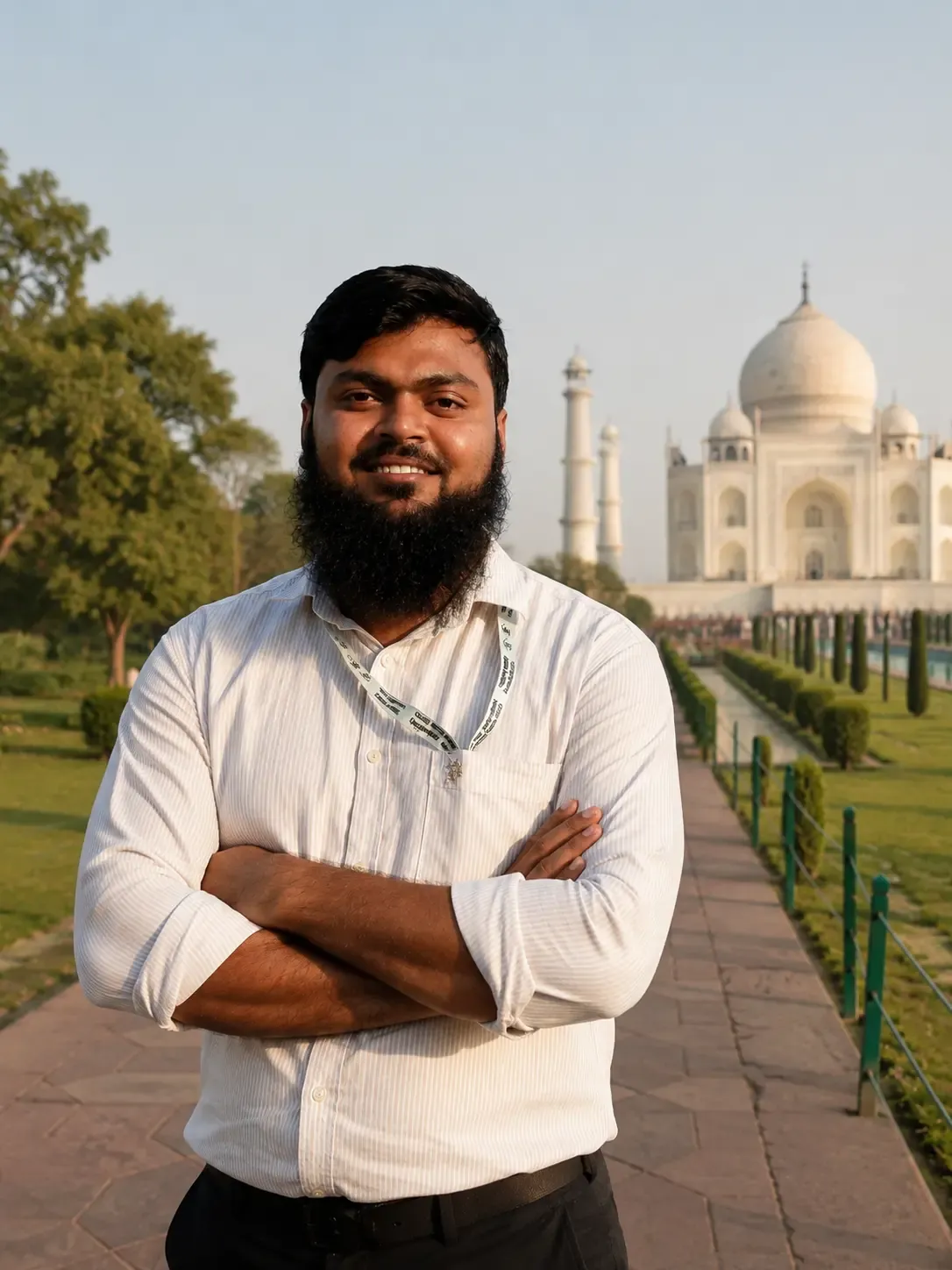
Kamran Khan — Licensed Tour Guide Fatehpur Sikri Agra
IITG Govt. Licensed Lic. Oficial

Kamran Khan

Fatehpur Sikri is the monument I argue about most with other guides. They call it a day trip from Agra. I call it the most intellectually demanding site in the Indian subcontinent — a place that requires you to hold five simultaneous arguments in your mind to understand what you are looking at. The abandonment. The syncretism. The engineering of the Diwan-i-Khas column. The inscription at the Buland Darwaza. The saint’s jali. None of these are separate stories. They are all the same story, told by the same man, about the same question: what does it mean to build an empire that will last?

Fatehpur Sikri es el monumento sobre el que más discuto con otros guías. Ellos lo llaman una excursión de un día desde Agra. Yo lo llamo el sitio intelectualmente más exigente del subcontinente indio — un lugar que requiere que mantengas cinco argumentos simultáneos en tu mente para entender lo que estás mirando. El abandono. El sincretismo. La ingeniería de la columna del Diwan-i-Khas. La inscripción en el Buland Darwaza. El jali del santo. Ninguna de estas es una historia separada. Todas son la misma historia, contada por el mismo hombre, sobre la misma pregunta: ¿qué significa construir un imperio que dure?

I hold a Government Pan-India IITG licence — the highest certification in Indian tourism. For over a decade I have guided travellers from more than 40 nationalities through the monuments, markets, and stories of Rajasthan and Uttar Pradesh. I have stood inside the Diwan-i-Khas of Fatehpur Sikri more times than I can count and I still find something new in the column every time I explain it. That is what a great building does. It holds more than one answer.

Poseo la licencia nacional IITG del Gobierno — la certificación más alta del turismo indio. Durante más de una década he guiado a viajeros de más de 40 nacionalidades por los monumentos, mercados e historias de Rajastán y Uttar Pradesh. He estado dentro del Diwan-i-Khas de Fatehpur Sikri más veces de las que puedo contar y todavía encuentro algo nuevo en la columna cada vez que la explico. Eso es lo que hace un gran edificio. Contiene más de una respuesta.

English Español हिन्दी اردو